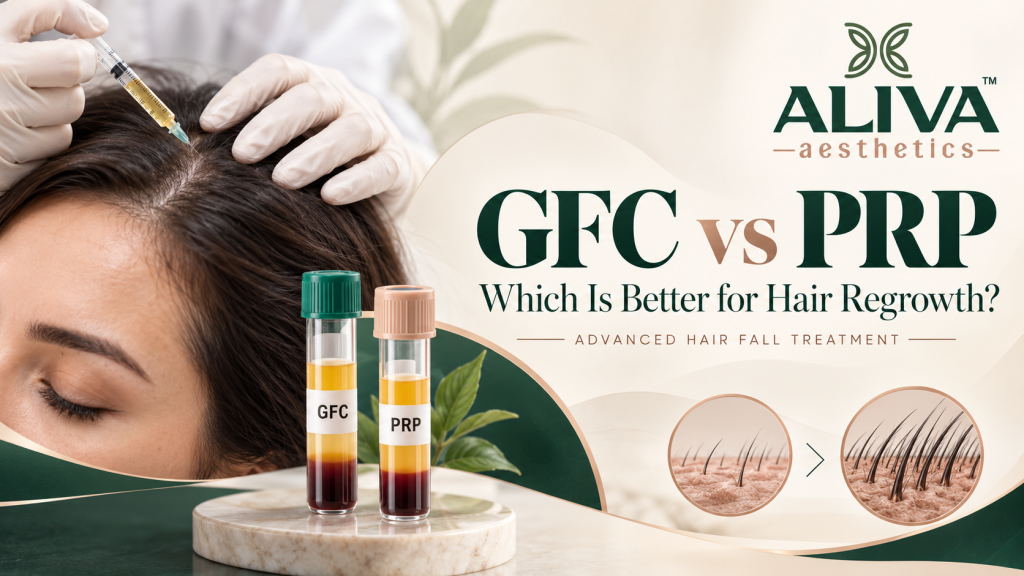
GFC vs PRP Hair Treatment: Which Is Better for Hair Regrowth?
Hair fall and thinning hair are common concerns for both men and women. If you are exploring advanced hair regrowth solutions, understanding GFC vs PRP hair treatment can help you compare the two options. Both treatments use components derived from your own blood, but they differ in preparation and application. In this guide, Aliva Aesthetics explains their benefits, differences, limitations, and what to consider when choosing a hair treatment in Vijayawada or Guntur.
Additionally, environmental conditions and scalp problems may affect overall hair health. As a result, many people now explore professional hair fall treatment in Vijayawada and Guntur to manage thinning hair and improve hair growth.
When regular hair care products fail to deliver the expected results, people often consider two treatments: PRP and GFC. Both use components from your own blood and involve non-surgical procedures. However, they differ in preparation methods and the materials doctors inject into the scalp.
So, when comparing GFC vs PRP hair treatment, which option works better?
In this guide, the team at Aliva Aesthetics explains the differences, benefits, treatment process, and possible results. We also help you understand GFC vs PRP, which is better for your particular hair concerns.
What Is PRP Hair Treatment?
PRP stands for Platelet Rich Plasma. Doctors have used platelet-based therapies in several medical fields for many years. More recently, PRP has gained attention as a supportive treatment for certain types of hair loss.
Platelets contain natural growth factors that play a role in tissue repair. Therefore, doctors use platelet rich plasma for hair loss to support hair follicles and potentially improve hair thickness and density.
How PRP Works
The PRP treatment process involves four main steps:
- First, the doctor draws a small amount of blood from your arm.
- Next, a centrifuge spins the blood and separates it into different layers.
- The doctor then collects the platelet-rich plasma.
- Finally, the doctor injects the prepared plasma into the thinning areas of your scalp.
After injection, platelets release growth factors that may support hair follicle activity. Over time, some patients experience improvements in hair density and thickness.
For this reason, people with early-stage hair thinning often consider PRP hair treatment in Vijayawada after consulting a qualified specialist.
What PRP Contains
PRP mainly contains plasma with a higher concentration of platelets than ordinary blood. However, its exact composition depends on the preparation technique.
Some PRP preparations may also contain small amounts of red and white blood cells. These components can influence how the scalp responds to treatment.
Additionally, some patients may experience temporary tenderness, redness, or swelling after the injections.
What Is GFC Hair Treatment?
GFC stands for Growth Factor Concentrate. This treatment uses growth factors collected from your own blood through a specialised preparation process.
Like PRP, growth factor concentrate therapy aims to support hair follicle function. However, GFC preparation focuses on releasing and concentrating growth factors before the doctor injects the solution into the scalp.
As a result, GFC differs from conventional PRP in its processing method and final composition.
How GFC Works
The GFC procedure involves four main steps:
- First, the doctor collects a small amount of blood from your arm.
- Next, a specialised GFC kit processes the sample and activates the platelets to release growth factors.
- The doctor then separates the concentrated growth-factor solution.
- Finally, the doctor injects the prepared solution into the targeted areas of your scalp.
Unlike conventional PRP, which contains platelets that release growth factors after preparation, GFC aims to deliver growth factors that the processing method has already released.
Because of this difference, some patients explore GFC hair treatment in Vijayawada as another option for managing hair thinning.
However, treatment outcomes depend on several factors, including the cause of hair loss, preparation method, and individual response.
What GFC Contains
GFC contains growth factors collected through a specialised blood-processing technique.
The preparation process aims to reduce unwanted cellular components while concentrating the growth factors. However, the exact composition depends on the kit and processing method.
Some studies suggest that certain GFC preparations may cause less injection discomfort than PRP. Nevertheless, patients can experience temporary tenderness, redness, or swelling with either treatment.
GFC vs PRP Hair Treatment: Side-by-Side Comparison
Understanding the differences between these treatments can help you make an informed decision.
| Factor | PRP Hair Treatment | GFC Hair Treatment |
| Full form | Platelet Rich Plasma | Growth Factor Concentrate |
| Source | Your own blood | Your own blood |
| What doctors inject | Platelet-rich plasma | Prepared growth-factor concentrate |
| Preparation | Centrifuge-based platelet separation | Specialised growth-factor preparation |
| Composition | Contains concentrated platelets | Focuses on released growth factors |
| Comfort | Mild discomfort or swelling may occur | Mild discomfort or swelling may occur |
| Sessions | Depends on the treatment plan | Depends on the treatment plan |
| Downtime | Usually minimal | Usually minimal |
| Cost per session | Often comparatively lower | May be higher because of specialised processing |
| Suitable candidates | Selected patients with pattern hair loss | Selected patients with pattern hair loss |
| Results | May improve hair density and thickness | May improve hair density and thickness |
Both treatments have shown promising results in clinical studies. However, researchers still need larger, high-quality studies to determine whether one consistently performs better than the other.
GFC vs PRP: Which Is Better for Hair Regrowth?
Both treatments may help improve hair density and thickness in suitable patients. However, neither treatment guarantees complete hair regrowth.
The best choice depends on your hair loss condition, medical history, treatment goals, and budget.
When GFC May Be the Better Choice
Your doctor may consider GFC if:
- You want to explore a growth-factor-based treatment.
- You prefer a specialised blood-processing method.
- You have early or moderate pattern hair thinning.
- You want to discuss alternatives to conventional PRP.
- You need a personalised treatment plan after a scalp examination.
Additionally, some patients may experience less injection discomfort with certain GFC preparations. However, comfort and recovery can vary between individuals.
Therefore, a dermatologist should evaluate your hair condition before recommending growth factor concentrate therapy.
When PRP May Be the Better Choice
Your doctor may recommend PRP if:
- You have early-stage pattern hair thinning.
- You want a treatment with a longer history of clinical use.
- You prefer an option that may cost less per session.
- You are exploring professional hair loss treatment for the first time.
- Your doctor considers PRP suitable for your scalp condition.
Platelet rich plasma for hair loss has received considerable attention in clinical research. Several studies suggest that it can improve hair density and thickness in selected patients.
However, individual results vary, and some patients may need other medical treatments alongside PRP.
The Bottom Line on GFC vs PRP: Which Is Better?
When comparing GFC vs PRP hair treatment, neither option is automatically better for every patient.
PRP has a longer history of clinical use for hair loss. Meanwhile, GFC uses a specialised method to prepare concentrated growth factors.
Although some studies report favourable outcomes with GFC, current evidence does not conclusively prove that it delivers better hair regrowth than PRP.
Therefore, your doctor should consider your diagnosis, scalp condition, expectations, and budget before suggesting a treatment.
Most importantly, a proper scalp evaluation helps you choose a suitable approach instead of following treatment trends.
Who Is a Good Candidate for GFC or PRP?
Doctors may consider GFC or PRP for people experiencing certain types of hair loss.
Potential candidates include individuals with:
- Male or female pattern hair loss
- Early receding hairlines
- Thinning hair at the crown
- Widening hair partings
- Reduced hair density
- Early to moderate pattern hair thinning
- Hair thinning that requires further specialist evaluation
In addition, some doctors may discuss these treatments as supportive options after a hair transplant.
However, not every type of hair loss responds to platelet-based treatments.
For example, temporary shedding after pregnancy, illness, or significant stress may need a different approach. Therefore, your doctor should identify the underlying cause before recommending injections.
These treatments may also be unsuitable for people with certain blood disorders, very low platelet counts, active scalp infections, or other medical conditions.
If you take blood-thinning medicines, tell your doctor before considering treatment. Similarly, pregnant or breastfeeding women should discuss treatment safety with their healthcare professional.
If an area has experienced permanent follicle loss, GFC or PRP alone is unlikely to restore hair growth. In such situations, a specialist may discuss other options, including hair transplantation.
How Many Sessions Will You Need?
The number of sessions depends on your hair loss condition, treatment response, and the protocol your doctor recommends.
PRP Hair Treatment
Doctors may recommend an initial series of approximately 4 to 6 sessions, often spaced 3 to 4 weeks apart. Some patients may also need maintenance sessions.
GFC Hair Treatment
Some GFC protocols involve approximately 3 to 5 sessions, often spaced about four weeks apart. However, the number of sessions can vary.
These are examples rather than fixed treatment requirements.
Additionally, there is no guarantee that GFC needs fewer sessions than PRP.
Some patients notice reduced shedding or changes in hair thickness over several months. However, results vary, and not everyone experiences visible new hair growth.
Therefore, regular follow-up appointments help your doctor assess your response and adjust your hair regrowth treatment plan when necessary.
What to Expect During the Procedure
Whether you choose GFC hair treatment in Guntur or PRP hair treatment in Guntur, the procedure generally follows a similar process.
At Aliva Aesthetics, the treatment appointment may take approximately 45 minutes to an hour, depending on the procedure and individual needs.
Step 1: Consultation and Scalp Analysis
First, the doctor examines your scalp and reviews your hair loss history. Additionally, the doctor may recommend tests if your symptoms suggest an underlying medical condition.
Step 2: Blood Collection
Next, the healthcare professional draws a small blood sample from your arm, similar to a routine blood test.
Step 3: Blood Processing
The team then processes the sample using the appropriate PRP or GFC preparation method.
Step 4: Scalp Preparation
Before treatment, the doctor cleans your scalp. The doctor may also apply numbing cream to help reduce discomfort.
Step 5: Injection
Next, the doctor uses fine needles to inject the prepared solution into the targeted scalp areas.
Step 6: Aftercare Guidance
Finally, the team explains the aftercare instructions and any activities you should avoid temporarily.
Most patients can return to their regular daily activities soon after the procedure. However, your doctor may recommend specific precautions.
Aftercare Tips for Better Results
Proper aftercare helps protect your scalp and supports a comfortable recovery.
Follow these general precautions after treatment:
- Avoid washing your hair for approximately 24 hours if your doctor recommends it.
- Skip hair colouring, chemical treatments, and excessive heat styling for a few days.
- Avoid intense exercise, swimming, and saunas for 24 to 48 hours if advised.
- Do not massage or press the treated scalp aggressively.
- Drink enough water and maintain a balanced, protein-rich diet.
- Avoid smoking and limit alcohol consumption.
- Use only the scalp products and medicines your doctor recommends.
- Attend follow-up appointments to monitor your treatment response.
Most importantly, follow the personalised instructions your treating doctor provides.
Are There Any Side Effects?
Both PRP and GFC use components from your own blood. As a result, allergic reactions to the blood-derived material are uncommon.
However, the injection procedure can still cause temporary side effects.
These may include:
- Mild scalp tenderness
- Temporary redness
- Slight swelling
- Scalp tightness
- Minor bruising
- Temporary discomfort at the injection sites
Most mild reactions improve within a short period. However, recovery times vary between patients.
Although uncommon, more serious complications, including infection, can occur after scalp injections.
Therefore, choose a qualified medical professional who follows appropriate hygiene and injection safety procedures.
When looking for the best hair clinic in Guntur or Vijayawada, consider the doctor’s qualifications, consultation process, treatment guidance, and safety practices rather than focusing only on price.
Why Choose Aliva Aesthetics for GFC and PRP Hair Treatment?
At Aliva Aesthetics, we focus on understanding each patient’s hair concerns before recommending a treatment.
We offer professional hair fall treatment in Vijayawada and consultations for patients exploring hair restoration options in Guntur.
Our approach focuses on identifying possible causes of hair loss and creating suitable treatment plans based on individual needs.
What You Can Expect at Aliva Aesthetics
- Detailed scalp analysis: We examine your scalp and review your hair loss history before discussing treatment options.
- Professional consultation: Our team explains the possible causes of hair thinning and available treatment approaches.
- Personalised treatment planning: We discuss suitable options, which may include GFC, PRP, prescribed medication, or nutritional guidance.
- Hygienic treatment procedures: We prioritise cleanliness and appropriate safety practices during treatment.
- Clear treatment guidance: We explain the expected treatment process, possible side effects, session requirements, and costs.
- Convenient locations: We help patients explore hair care and aesthetic treatment options in Vijayawada and Guntur.
If you are considering GFC hair treatment in Vijayawada or PRP hair treatment in Guntur, our team can help you understand the available options.
Book your hair consultation at Aliva Aesthetics today.
Take the first step towards understanding your hair loss and choosing a treatment plan that suits your needs.
Frequently Asked Questions (FAQs)
1. GFC vs PRP, which is better for hair regrowth?
Both GFC and PRP may help improve hair density and thickness in suitable patients. However, current research does not establish that one treatment consistently works better than the other. Therefore, the best choice depends on your hair loss condition, medical history, and treatment goals.
2. Is growth factor concentrate therapy painful?
Growth factor concentrate therapy involves small injections into the scalp, so you may experience mild discomfort. However, the doctor may apply numbing cream to improve comfort. Some studies report less injection pain with certain GFC preparations, but individual experiences vary.
3. How soon will I see results?
Some patients notice changes in hair shedding or thickness over several months. In certain cases, visible improvements may appear within 3 to 6 months. However, results depend on your condition, treatment plan, and individual response.
4. Are the results permanent?
PRP and GFC do not permanently stop every cause of hair loss. For example, genetic hair thinning may continue over time. Therefore, some patients need ongoing medical treatment or maintenance sessions to support their results.
5. Is platelet rich plasma for hair loss safe for women?
Doctors may consider platelet rich plasma for hair loss for selected women with pattern hair thinning. However, treatment suitability depends on the cause of hair loss and medical history. Pregnant or breastfeeding women should discuss safety with their doctor because evidence for use during these periods is limited.
6. Can GFC or PRP be done after a hair transplant?
Doctors sometimes use PRP or GFC as supportive treatments after hair transplantation. However, research has not established that these treatments guarantee better graft survival or hair density. Therefore, your transplant specialist should decide whether either treatment is appropriate and when to schedule it.
7. What is the cost of GFC hair treatment in Vijayawada?
The cost of GFC hair treatment in Vijayawada depends on the clinic, treatment protocol, and number of sessions. Additionally, specialised preparation kits may increase the cost per session. Visit Aliva Aesthetics for a consultation and personalised treatment estimate.
8. What is the cost of PRP hair treatment in Vijayawada?
The cost of PRP hair treatment in Vijayawada depends on the preparation technique, treatment area, and number of sessions. PRP may cost less per session than GFC at some clinics. However, your doctor can provide a clearer estimate after reviewing your needs.
9. How many sessions of GFC are required?
Some doctors recommend an initial series of approximately 3 to 5 GFC sessions, often spaced about a month apart. However, treatment protocols vary, and some patients may need additional or maintenance sessions. Your doctor will recommend a schedule after examining your scalp.
10. Where can I get GFC hair treatment in Guntur?
Aliva Aesthetics offers consultations for patients exploring GFC hair treatment in Guntur and PRP hair treatment in Guntur. Our team also provides hair loss assessments and treatment guidance for patients in Vijayawada. Contact the clinic to confirm current treatment availability at your preferred location and schedule a consultation.