
Medically reviewed by Dr. Akhil Chadala, Dermatologist, Aliva Aesthetics · Last reviewed 11 September 2026
Pigmentation returns for a simple reason: most people treat the marks and never treat the trigger. Indian skin produces more melanin and produces it faster in response to sun, inflammation, heat, and hormones. Fade the spots without controlling what is causing them, and they come back within months.
The second reason is that different types of pigmentation look similar but respond to completely different treatments. Melasma and acne marks can appear almost identical on the cheeks, yet a treatment that clears one can visibly worsen the other. Getting the diagnosis right matters more than the strength of the product.
This guide explains the types of pigmentation affecting Indian skin, what triggers each one, what actually works, and why so many home remedies make things worse.
Quick orientation
- Symmetrical brown patches on both cheeks → likely melasma
- Dark marks where a pimple used to be → post-inflammatory hyperpigmentation
- Even darkening on face, neck, arms → sun tanning
- Small scattered spots that darken in summer → freckles or sun spots
- Darkness under both eyes → periorbital melanosis
- Sunscreen is non-negotiable for every one of these
Why Indian skin pigments more easily
Indian skin generally falls into Fitzpatrick types IV to VI, meaning it contains more active melanocytes producing more melanin. This is genuine protection — it is why skin cancer rates are lower here than in fair-skinned populations.
The trade-off is reactivity. Those same melanocytes respond aggressively to any insult. A pimple, an insect bite, a scratch, a wax strip, or an hour of midday sun can all trigger a burst of melanin production that lingers for months after the original injury has healed. Fair skin reddens and recovers; brown skin darkens and remembers.
This is why pigmentation is the most common reason people in India see a dermatologist, and why treatment here needs a different approach from protocols designed for lighter skin. Aggressive lasers and high-strength peels that are routine elsewhere can cause paradoxical darkening on Indian skin.
Types of pigmentation — and how to tell them apart
Melasma
Symmetrical brown or greyish-brown patches, usually across the cheeks, forehead, upper lip, and bridge of the nose. The edges are irregular but the pattern is noticeably mirror-image on both sides of the face.
Melasma is hormone-driven and sun-aggravated. It commonly appears during pregnancy, with oral contraceptive use, or with thyroid conditions, and affects women far more than men. It is the most stubborn type of pigmentation to treat and the most likely to return. Heat itself is a trigger, independent of UV, which is why it flares in Indian summers even with sun protection.
Melasma is managed rather than cured. Realistic treatment aims for substantial fading and long-term control, not permanent clearance.
Post-inflammatory hyperpigmentation
Flat dark marks left behind after the skin has been inflamed — most often after acne, but also after eczema, insect bites, cuts, burns, or cosmetic procedures.
The key distinguishing feature is history: the mark sits exactly where something happened. It follows the shape of the original lesion rather than forming a symmetrical pattern.
These marks fade on their own, but slowly — six months to two years without treatment. Treatment accelerates that considerably. The critical point is that new marks keep forming while the underlying cause continues, so treating active acne has to come before or alongside treating the marks. Clearing old pimple marks while new pimples keep appearing is a losing sequence.
Note the distinction from acne scars: a mark is flat and a colour change, a scar is a change in skin texture — a pit, a depression, or raised tissue. Marks respond to pigment treatment. Scars need resurfacing. Many people have both, and they are treated differently.
Sun tanning
Diffuse, even darkening on areas that get sun exposure — face, neck, forearms, the V of the chest — with a visible line where clothing covered the skin.
Tanning is the most straightforward type to treat and the most commonly ignored, because it develops gradually enough that people adjust to it. Cumulative sun exposure also drives premature ageing and worsens every other type of pigmentation.
Freckles and sun spots
Small, well-defined brown spots. Freckles appear early in life, are genetic, and darken with sun exposure. Solar lentigines, or sun spots, appear later from accumulated UV damage and do not fade in winter the way freckles do.
Both respond well to treatment, and both return with unprotected sun exposure.
Dark circles
Darkness under the eyes has several distinct causes, which is why generic under-eye creams so often fail. It may be true pigmentation of the thin skin, visible blood vessels showing through, a shadow cast by hollowing or eye bags, or a combination.
Pigmentary dark circles respond to pigment treatment. Vascular and structural ones do not and need a different approach entirely. A proper under-eye assessment identifies which type you have before anything is prescribed.
Less common types
Some pigmentation patterns need dermatological diagnosis rather than cosmetic treatment — pigmented contact dermatitis from cosmetics or hair dye, lichen planus pigmentosus, ashy dermatosis, and drug-induced pigmentation. These can be mistaken for melasma and treated wrongly for years. If a patch has an unusual pattern, is spreading, or is not responding to standard treatment, it needs a proper diagnosis.
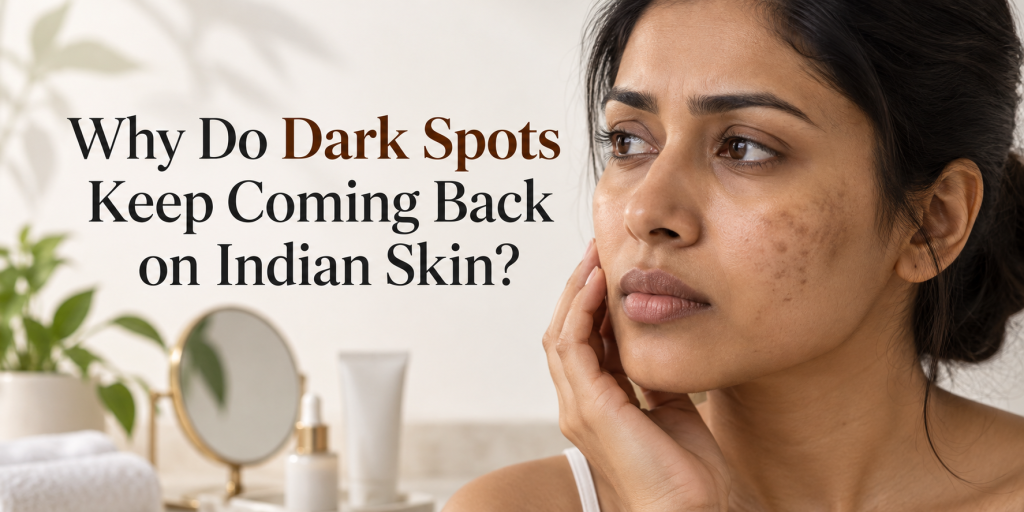
Why Do Dark Spots Keep Coming Back on Indian Skin?
- Ultraviolet light — the single largest driver, including on cloudy days and through windows
- Visible light — high-energy visible and blue light from sun and screens worsens melasma specifically, which is why plain UV sunscreens sometimes underperform
- Heat — infrared and ambient heat trigger melanocytes independently of UV, relevant in Andhra Pradesh’s climate
- Hormones — pregnancy, oral contraceptives, hormonal therapy, thyroid disorders
- Inflammation — acne, eczema, allergic reactions, aggressive scrubbing, threading, waxing
- Friction — rubbing, tight clothing, repeated scratching
- Irritating products — harsh actives, unregulated creams, frequent product-switching
- Genetics — family history strongly predicts melasma risk
Treatments that work
Effective pigmentation treatment almost always combines several approaches rather than relying on one.
Topical treatment forms the foundation. Dermatologists use combinations of tyrosinase inhibitors and antioxidants — ingredients such as azelaic acid, kojic acid, niacinamide, vitamin C, arbutin, and retinoids — matched to your pigmentation type and skin tolerance. Prescription options including hydroquinone and tranexamic acid are used under supervision and in cycles, not continuously.
Chemical peels remove pigmented surface layers and stimulate turnover. On Indian skin, the approach is a series of superficial to medium-depth peels using glycolic, mandelic, salicylic, or lactic acid rather than a single aggressive one. Mandelic acid is often preferred for darker skin because the larger molecule penetrates more gently and carries less risk of triggering rebound pigmentation.
Laser and light-based treatment targets melanin directly. Q-switched Nd:YAG is the workhorse for Indian skin because its wavelength reaches pigment without excessive heating of surrounding tissue. Settings must be conservative — over-treatment on brown skin causes paradoxical darkening, and melasma in particular is easily worsened by aggressive lasering. This is a treatment where operator experience matters more than machine specification.
Microneedling and skin boosters improve delivery of active ingredients and stimulate remodelling, often used alongside topical protocols rather than alone.
Oral treatment — oral tranexamic acid has good evidence in resistant melasma, prescribed with screening for clotting risk. Antioxidant supplementation plays a supporting role.
Skin rejuvenation protocols combine several of the above in a planned sequence, which is generally how stubborn pigmentation is actually cleared.
Your dermatologist selects from these based on your pigmentation type, depth, skin tolerance, and history. Epidermal pigment sits nearer the surface and responds faster; dermal pigment sits deeper and takes considerably longer.
What does not work — and what makes it worse
This section matters more than the treatment list, because most pigmentation seen in clinic has been made worse by something the patient tried first.
Lemon juice. Highly acidic, photosensitising, and a common cause of phytophotodermatitis — a burn reaction that leaves darker pigmentation than what you started with. It is probably the single most damaging home remedy in circulation.
Scrubbing and exfoliating aggressively. Pigmentation is not dirt sitting on the surface. Physical scrubbing inflames the skin, and inflammation triggers more melanin. Harsh ubtans and gritty scrubs used daily reliably worsen pigmentation.
Fairness creams and unregulated products. Many contain undisclosed steroids, mercury, or high-strength hydroquinone. Topical steroids used on the face cause skin thinning, visible capillaries, steroid-induced acne, and rebound pigmentation worse than the original problem when stopped. Steroid-damaged facial skin is one of the most common and most difficult presentations in Indian dermatology clinics.
Prescription creams borrowed or bought without supervision. Hydroquinone is effective and legitimate, but continuous unsupervised use can cause ochronosis — a blue-black discolouration that is extremely difficult to reverse.
Skipping sunscreen while treating. Every treatment above is undone by unprotected sun exposure. This is not a supplementary recommendation; it is the treatment.
Changing products every few weeks. Pigment treatment takes months. Product-hopping means nothing gets long enough to work and the skin stays irritated.
How long does treatment take for Clearing Darkspots
Pigmentation responds slowly, and honest expectations prevent people abandoning treatment just before it starts working.
| Type | Typical visible improvement | Notes |
|---|---|---|
| Sun tanning | 4–8 weeks | Fastest to respond |
| Post-inflammatory marks | 2–4 months | Faster if the underlying acne is controlled |
| Freckles and sun spots | 2–4 months | Recur without sun protection |
| Epidermal melasma | 3–6 months | Needs ongoing maintenance |
| Dermal or mixed melasma | 6–12 months | Managed, not cured |
| Pigmentary dark circles | 3–6 months | Depends on correct type identification |
Anyone promising to clear melasma permanently in a few sessions is describing something that does not happen.
Preventing recurrence
Sunscreen, correctly used. SPF 30 or higher, broad spectrum, applied every morning regardless of weather or whether you are going out — UVA passes through window glass. Reapply every three to four hours outdoors. For melasma specifically, a tinted sunscreen containing iron oxide blocks visible light that clear sunscreens do not.
Most people use roughly a quarter of the amount needed. For the face and neck, that is about two finger-lengths of product.
Physical protection. A wide-brimmed hat and sunglasses do more than any product during peak hours. Avoid direct sun between 10 AM and 4 PM where you can.
Treat inflammation early. Every pimple left to run its course, every patch of eczema left untreated, leaves a mark on Indian skin. Early treatment of the cause prevents the pigmentation entirely.
Do not pick. Squeezing a pimple converts a few days of redness into several months of dark marking.
Maintain, don’t stop. Pigmentation prone skin stays pigmentation prone. Maintenance protocols keep results; stopping entirely usually means slow recurrence.
When to see a dermatologist
Book an assessment if pigmentation is spreading, has changed in appearance, has not responded to three months of consistent care, followed a new medication or cosmetic product, or is affecting your confidence. Also see a doctor for any single spot that is growing, changing colour, has irregular borders, itches, or bleeds — that needs medical assessment rather than cosmetic treatment.
Book a skin consultation at Aliva Aesthetics
Aliva Aesthetics provides pigmentation treatment, chemical peels, laser therapy, and complete skin care at our clinics in Vijayawada and Guntur. Every consultation starts with identifying which type of pigmentation you have, because the treatment that clears one type can worsen another.
Vijayawada: +91 98514 74474 · Guru Nanak Colony, Vijayawada – 520008 Guntur: +91 97049 45577 · Ashok Nagar, Lakshmi Puram, Guntur – 522002 Open Mon–Sun, 10 AM – 8 PM
Frequently asked questions
Can pigmentation be removed permanently?
Sun tanning, freckles, and post-inflammatory marks can clear completely and stay clear with consistent sun protection. Melasma is different — it is managed rather than cured, and typically returns without maintenance. Any clinic promising permanent melasma clearance is overstating what treatment can do.
Why does my pigmentation come back after treatment?
Usually because the trigger was never addressed. Unprotected sun exposure, ongoing hormonal influence, continuing acne, or stopping maintenance treatment all allow pigment to return. Treatment fades existing pigment; only trigger control prevents new pigment forming.
Is laser treatment safe for Indian skin?
Yes, with the right laser and conservative settings. Q-switched Nd:YAG is generally suitable for darker skin tones. The risk is over-treatment, which can cause paradoxical darkening rather than lightening. Operator experience with Fitzpatrick IV–VI skin matters more than the equipment.
How can I tell melasma from acne marks?
Melasma forms symmetrical patches on both cheeks, forehead, or upper lip with irregular edges. Post-inflammatory marks sit exactly where a pimple or injury was and follow its shape. If both cheeks mirror each other, it is more likely melasma. A dermatologist can confirm with examination.
Do fairness creams help with pigmentation?
No, and many actively worsen it. Unregulated products frequently contain undisclosed steroids or mercury that cause skin thinning, steroid-induced acne, and rebound pigmentation worse than the original. Treating pigmentation means correcting uneven tone, which is a different goal from changing your natural complexion.
Does drinking water or diet clear pigmentation?
Hydration and a diet rich in antioxidants support skin health but will not clear established pigmentation. Melanin production is driven by UV, heat, hormones, and inflammation. No dietary change substitutes for sun protection and appropriate topical or procedural treatment.
Can pigmentation be treated during pregnancy?
Sun protection and certain gentle topicals are safe, but many active ingredients including retinoids, hydroquinone, and oral tranexamic acid are not used in pregnancy. Pregnancy-related melasma often fades on its own within several months after delivery. Tell your dermatologist if you are pregnant or breastfeeding.