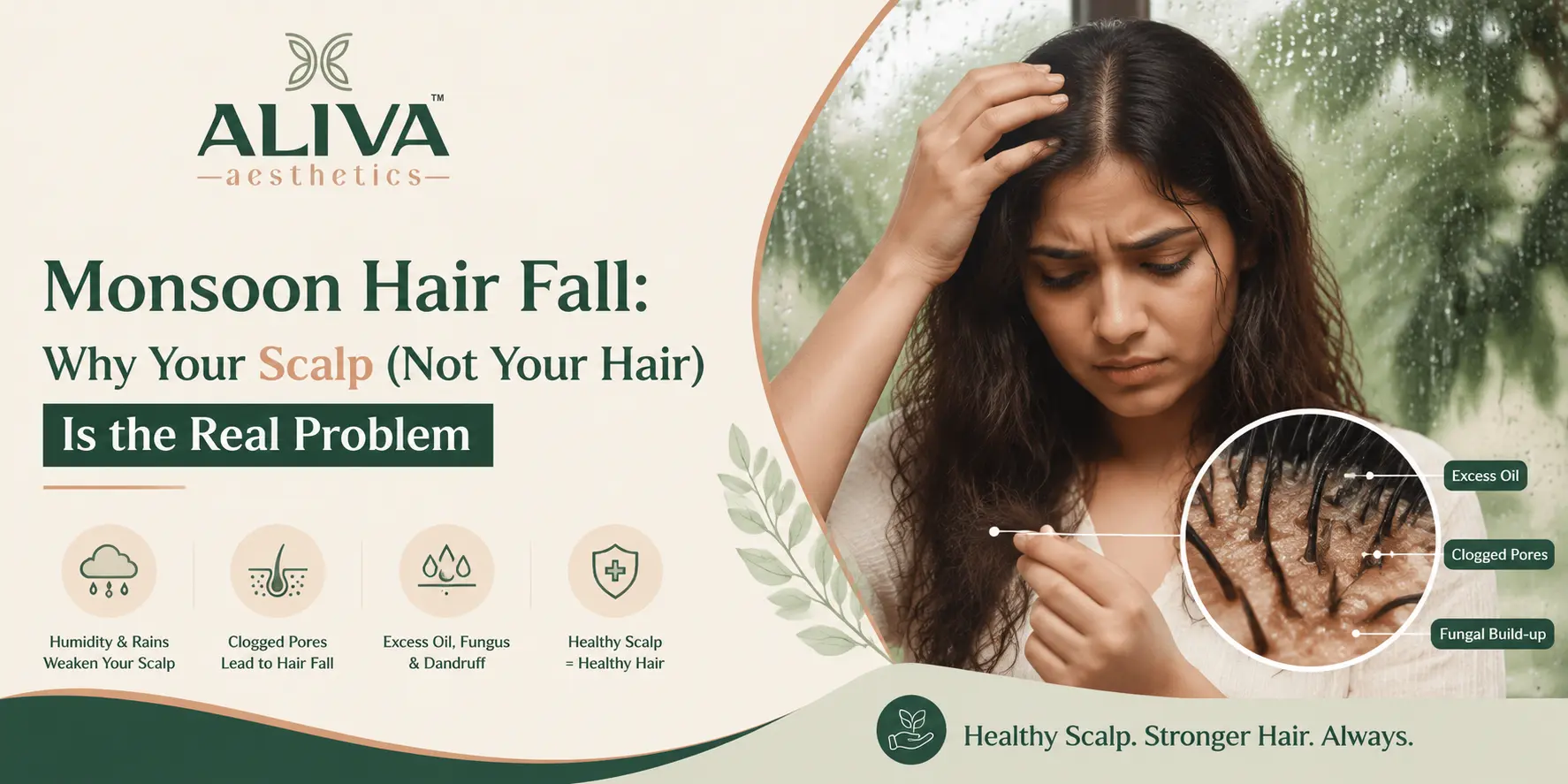
Quick Answer: Monsoon hair fall is usually caused by scalp problems, not weak hair. High humidity increases sweat, oil, and product buildup on the scalp. This can trigger dandruff, fungal irritation, and clogged follicles, which disturb the natural hair growth cycle and increase shedding. Treating the scalp — not just the strands — is the key to controlling monsoon hair fall.
Every year, as the rains arrive in Vijayawada, we see the same pattern at our clinic. Patients notice extra strands on the pillow, in the comb, and in the shower drain. Most of them panic and buy new shampoos or hair oils. However, the real issue is rarely the hair itself.
In this guide, our dermatologists explain why hair fall increases in the rainy season, what is actually happening on your scalp, and when home care is no longer enough.
Does Monsoon Cause Hair Fall?
Yes, hair fall commonly increases during the monsoon — but the trigger is the scalp environment, not the season itself. Humidity levels rise sharply during the rainy months in coastal Andhra Pradesh. Your scalp responds by producing more sweat and sebum (natural oil). Combined with pollution, rainwater exposure, and product buildup, this creates the perfect environment for scalp irritation.
Shedding 50–100 strands a day is considered normal by dermatologists. During the monsoon, many people notice this number rise. The good news? Seasonal shedding is usually temporary and reversible when the underlying scalp issue is treated early.
Why Your Scalp Is the Real Problem: 5 Monsoon Triggers
1. Excess Sebum and Sweat Buildup
Humidity makes your scalp oilier than usual. This oil traps dust and dead skin cells around the follicle openings. As a result, follicles get clogged, and hair roots weaken over time.
2. Dandruff and Fungal Overgrowth
A warm, damp scalp is an ideal home for Malassezia, the fungus linked to dandruff and seborrheic dermatitis. Itching, flaking, and inflammation follow — and an inflamed scalp sheds more hair. This is one of the most common monsoon scalp problems we treat at our clinic.
3. Wet Hair Left Damp for Too Long
Hair is weakest when wet. Tying up damp hair or sleeping with a wet scalp stretches and breaks strands. Moreover, a scalp that stays damp for hours becomes more prone to fungal irritation.
4. Rainwater Exposure
Rainwater in urban areas can carry pollutants and dust. When it sits on the scalp, it can cause itching and irritation. Therefore, always rinse your hair with clean water after getting drenched.
5. Disturbed Hair Growth Cycle (Telogen Effluvium)
Persistent scalp inflammation can push more follicles into the resting (telogen) phase of the growth cycle. In simple terms, an unhealthy scalp tells more hairs to “pause and fall.” This is why treating the scalp restores hair better than any strand-level product.
How to Stop Hair Fall in Monsoon: A Dermatologist-Approved Routine
Follow these steps consistently through the rainy season:
- Wash your scalp 3–4 times a week with a gentle, pH-balanced shampoo. In humid weather, under-washing causes more damage than over-washing.
- Dry your scalp completely before tying your hair or sleeping.
- Avoid heavy oils and styling products during peak humidity — they add to buildup.
- Rinse after rain exposure with clean water as soon as possible.
- Eat protein and iron-rich foods — deficiencies are a common hidden cause of shedding, especially in women.
- Do not scratch an itchy scalp — it worsens inflammation and breakage.
If flaking, itching, or shedding continues for more than 6–8 weeks despite these steps, the problem needs medical evaluation.
When Should You See a Dermatologist for Hair Fall?
See a dermatologist if hair fall lasts beyond 6–8 weeks, if you notice visible thinning or a widening parting, or if scalp itching and flakes do not improve with regular washing. Early diagnosis is the biggest factor in successful hair restoration — follicles are far easier to protect than to revive.
At Aliva Aesthetics, a dermatologist first examines your scalp to identify the actual cause: fungal infection, seborrheic dermatitis, nutritional deficiency, hormonal imbalance, or early pattern hair loss. Your treatment plan depends on this diagnosis — never on guesswork.
Hair Fall Treatment in Vijayawada: What Are Your Options?
Depending on the cause and stage of hair fall, our dermatologists may recommend:
| Treatment | Best Suited For | How It Helps |
|---|---|---|
| Medicated scalp therapy | Dandruff, fungal buildup, inflammation | Restores a healthy scalp environment |
| GFC Therapy | Early-stage thinning | Uses concentrated growth factors from your own blood to support follicle strength |
| PRP Therapy | Mild to moderate hair fall | Improves scalp circulation and follicle activity |
| QR678 Therapy | Progressive thinning | Growth-factor formulation delivered directly to the scalp |
| Hair Exosome Therapy | Advanced or treatment-resistant hair fall | Next-generation regenerative signals that support dormant follicles |
Every plan at our hair care clinic in Vijayawada begins with a scalp analysis and consultation, so treatment matches your specific condition. With a team experienced in 4000+ procedures, we focus on safe, minimally invasive, personalized care — and honest guidance on what results you can realistically expect. For a full comparison of every option, see our complete guide to hair fall treatment in Vijayawada.
Frequently Asked Questions
Is monsoon hair fall permanent?
No. In most cases, monsoon hair fall is temporary seasonal shedding linked to scalp imbalance. Once the scalp condition is treated and humidity reduces, normal growth typically resumes. However, if shedding continues beyond 8 weeks, consult a dermatologist to rule out underlying causes.
How many hair strands falling per day is normal?
Losing 50–100 strands per day is normal for most people. During the monsoon, a temporary increase is common. Consistent clumps of hair, visible scalp, or a widening parting are signs to seek medical advice.
Should I oil my hair during the monsoon?
Use oil sparingly in humid months. Heavy oiling on an already oily, damp scalp increases buildup and can worsen dandruff. If you oil, apply lightly 30–60 minutes before washing, not overnight.
Can dandruff cause hair fall?
Yes, indirectly. Dandruff itself does not destroy follicles, but the inflammation and scratching that come with it weaken roots and increase shedding. Treating dandruff early protects your hair.
What is the best hair fall treatment in Vijayawada?
There is no single “best” treatment — the right option depends on the cause and stage of your hair fall. At Aliva Aesthetics, options such as medicated scalp therapy, GFC, PRP, QR678, and exosome therapy are recommended only after a dermatologist’s scalp diagnosis.
Is a hair fall consultation available at Aliva Aesthetics?
Yes. Aliva Aesthetics, located in Guru Nanak Colony, Vijayawada (above Starbucks Cafe), is open every day from 9:00 AM to 9:00 PM. You can call +91 98514 74474, WhatsApp us, or book an appointment online for a scalp consultation. No prior appointment is required.
Worried about monsoon hair fall? Get your scalp examined by our dermatologists before temporary shedding becomes long-term thinning.
📞 Call +91 98514 74474 | 💬 WhatsApp Us | 🗓️ Book an Appointment | 📍 Aliva Aesthetics, Guru Nanak Colony, Vijayawada — Open 7 days, 9 AM–9 PM
Disclaimer: This article is for general information only and is not a substitute for a professional medical diagnosis. Individual results vary. Please consult a qualified dermatologist for advice specific to your condition.